

Early Stress Reduction Through Awareness and Self-Leadership
 Using intrapersonal skills allows burnout prevention
In most work situations and workplaces, stress is often normalized and ubiquitous, often accumulating unnoticed until it manifests as anxiety, burnout, or more severe mental health issues, such as depression.
The best approach to mitigating mental health risks involves intervening as early as possible by cultivating awareness of one's intrapersonal processes and actively leading or reshaping them. We point out that the early stress reduction is here the best and most effective method.
Such stress reduction is a proactive self-leadership strategy that draws from evidence-based awareness and intrapersonal skills practices, mindfulness studies, and cognitive behavioral techniques (for leading thoughts and behaviors). It is also supported by the science of yoga, which focuses on understanding processes within our own inner domain and achieving a mind that is able to remain naturally silent and peaceful.
The Power of Self-Observation
Becoming consciously observant of what processes are going on in your mind allows you to consciously notice the tension levels of those processes. Your intrapersonal turmoil arrives in the form of automatic thoughts, imaginations, emotions, desires, fears, anxiousness, and other inner subconscious reactions, as they arise in the moment. None of those processes is you (as True Self) or your identity.
Using your thoughts, imagination, and emotions as inner tools isn't the problem (see the graph). The problem is when those tools run on autopilot and gain speed. Spotting your own mental speed, emotional roller-coaster, and other tensions allows you to identify rising stress levels before the inner pressure escalates.
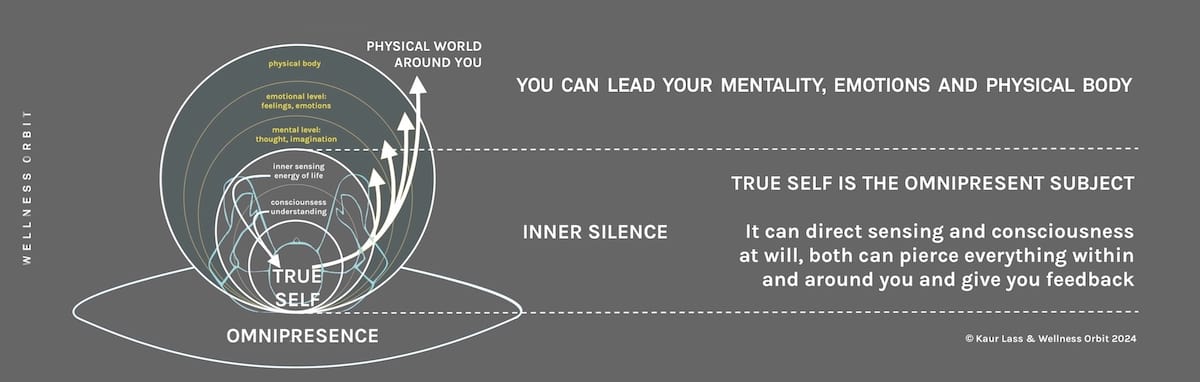
You don’t need an expert to tell you what is happening in your mind. You just need to become aware of what happens within your mind and be fully present in your physical body, and also use sensing and awareness to notice what is going on around you.
The Benefit of Conscious Response
Leading different mental and emotional processes and their combinations (like desires and habitual patterns) means intentionally disrupting unhelpful subconscious reactions by replacing them with conscious decisions and the responsibility of securing your inner calmness.
Your inner ability to respond means first and foremost making conscious decisions. This is what keeps you well and secures your inner freedom.
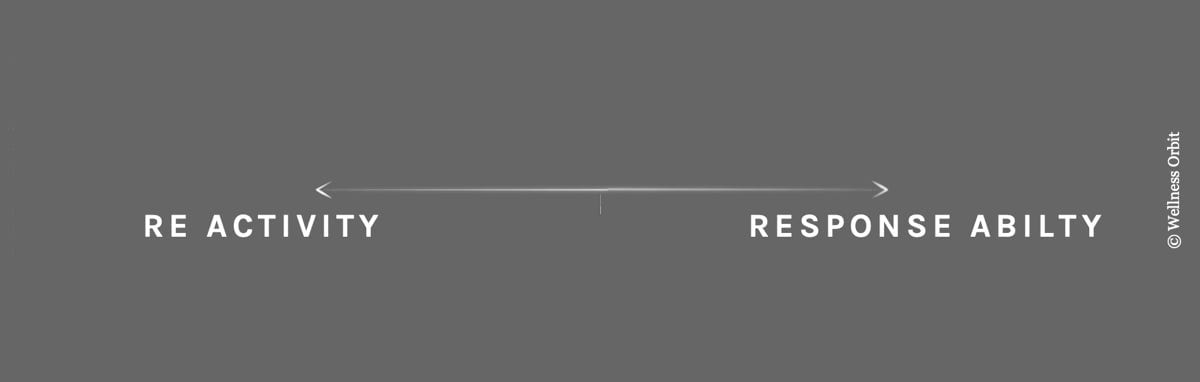
Taking full responsibility consciously reduces immediate stress and anxiety and allows your mind and body to become more relaxed.
Your relaxed awareness and non-judgmental responding are the source of long-term resilience, preventing downstream problems like chronic stress, anxiety, or emotional exhaustion that arrive as different stages of burnout.
Early intervention and stress reduction make burnout 100% preventable. However, training intrapersonal skills, while still feeling great or relatively well, is the key!
You just can’t use the skills to reduce stress and lead your thoughts, imagination, and emotions at will if your intrapersonal education is absent.
All skills are always personal. That is why intrapersonal skills need to be learned by every person on an individual level.
Why Early Intervention is the Best?
Research demonstrates that early intervention through leading awareness with awareness at will yields significant benefits. For instance, a scoping review of interventions for healthcare professionals found that early stress reduction programs, including mindfulness and cognitive strategies, effectively lowered burnout and improved overall well-being as part of workplace health promotion.
Studies have shown that dissatisfaction with workplace physical health protections was significantly associated with higher levels of emotional exhaustion. When your mind experiences constant pushing and speed, both your mind and body get depleted, and that is why burnout happens.
The problem with burnout is that it develops from low levels of stress to total exhaustion slowly, over many months or years. The closer you are to the final phase of burnout, the harder it becomes to change the downward spiral.
The above-linked paper ’Interventions to reduce stress and prevent burnout in healthcare professionals supported by digital applications: a scoping review’ mentions that “Interestingly, those who had participated in the intervention had lower baseline scores for work stress, job burnout, depression and work-related post-traumatic stress. This suggests that those who started the intervention already very stressed and with high levels of burnout did not find the time to complete it. Of course, it is those who would benefit the most. Here it is up to the employer, despite acute staff shortages, to create structures that enable participation – at best also in the interventions that take more time.”
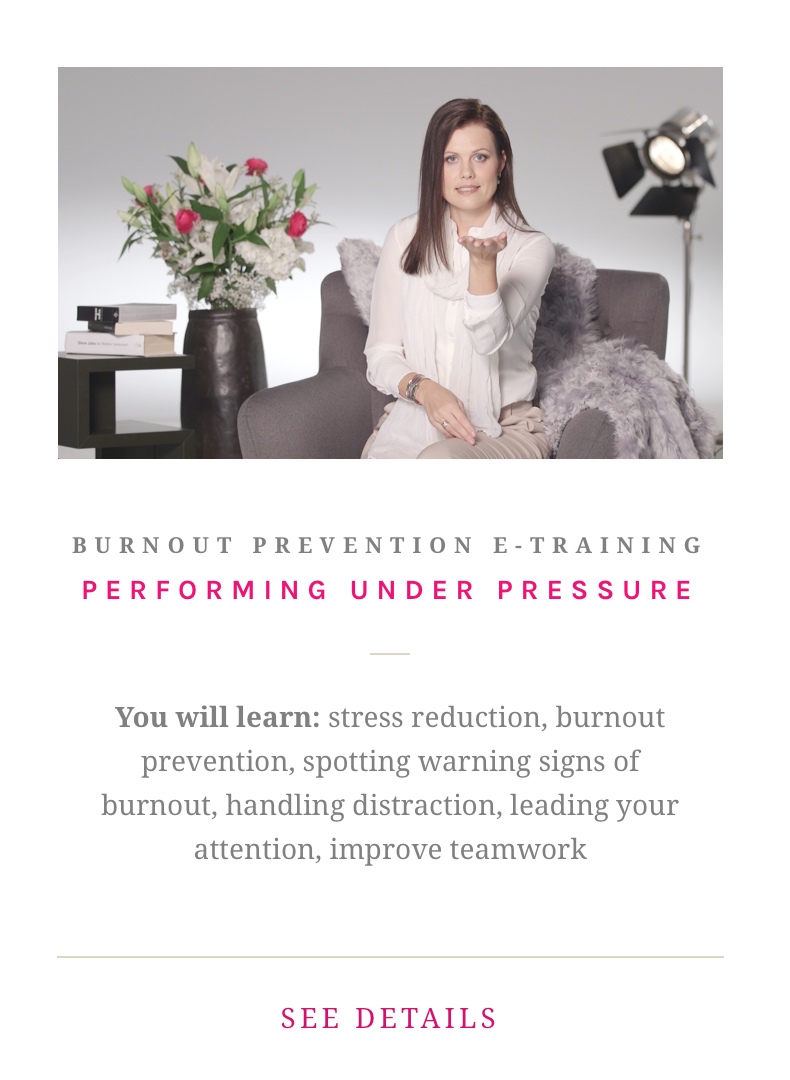
This is an interesting lesson. We have also seen it with our e-training ‘Performing Under Pressure’. People who evaluate their situation at the end of the training often give themselves a lower score than they did at the beginning. Why?
This typically happens because many people can’t accurately assess their stress levels and burnout risk if they lack awareness of their inner state.
Without the ability to observe and monitor their internal reactions, it is difficult to recognize how external stressors gradually turn into personal stress problems and then lead to burnout.
So, the key is timeliness: addressing stress at its onset disrupts the physiological and psychological buildup that leads to more entrenched issues.

Awareness is the Base of Leading Mental Processes
Awareness involves observing thoughts, imaginations, and emotions in your inner domain without judgment. Training intrapersonal skills equips you with the understanding of how you can lead those processes at will. This fosters a meta-cognitive perspective, where individuals notice stressors, such as work deadlines or interpersonal conflicts, in real time and then become aware of what gets triggered in them.
When you can notice and observe processes in your inner domain, you gain the power to reduce automatic subconscious reactivity. Leading processes builds on this noticing by employing intrapersonal skills for conscious self-leadership.
Also, when you notice negative thoughts, you can reframe them. For example, changing the thought "I can't handle this" to "I've managed similar challenges before" gives you inner power. When you then add behavioral experiments and start testing your assumptions through actions, you can learn by trial and error the path out of the problematic situation.
If psychological safety exists, mistakes become stepping stones to victories. Every person can make mistakes or lack knowledge. What matters is seeing this as an opportunity to learn and develop.
When you lead your awareness at will, it can identify distortions, and self-leadership corrects them. More aware self-leadership without judgment lowers your cortisol levels and enhances your power to lead your emotions at will.
When stress is low-grade, the brain's neuroplasticity allows quicker rewiring of habitual patterns that prevent the entrenchment of maladaptive patterns that fuel anxiety or burnout.
Preventing Burnout
Occupational burnout is often a hidden and costly challenge in contemporary workplaces, characterized by emotional exhaustion, cynicism, and reduced professional efficacy.
Burnout arises from chronic unmanaged stress and develops too slowly for the subconscious busy mind to spot.
|
.jpg "Take a personal stress test and enjoy feedback!")
It is awareness that allows early detection of exhaustion signals, while leading your processes consciously is both empowering and encourages boundary-setting and recovery behaviors. Self-insight is the key to changing your situation.
Early action is crucial. The study, 'Effectiveness of Workplace Mental Health Programs in Reducing Occupational Burnout: A Systematic Review', points out that “Person-centered approaches, such as stress management and resilience training, have demonstrated efficacy, particularly when combined with organizational-level interventions that address systemic workplace stressors.“
This study noted that participatory interventions demonstrated the best results and allowed for preventing burnout the best way, with results being visible for over a year.
That is why the online training ‘Performing Under Pressure’ includes self-evaluation tests, a workbook, and tests after each video session. Understanding combined with practice, added personal responsibility, and a personal development plan is what makes the difference.
The study also highlights that brief trainings and standalone digital tools aren't sufficient on their own. That is why we provide at least three months of access to the e-training. Our online trainings all combine self-evaluations and feedback, video training sessions, quizzes, workbooks, and clear graphical explanations that are easy to understand.
Conclusion
Early stress reduction safeguards broader mental health by enhancing resilience and well-being.
Awareness promotes emotional regulation, reducing vulnerability to both burnout and depression. Our observations with those who have completed our trainings and given us feedback confirmed reductions in stress and burnout symptoms, of course, provided that e-training participants applied what they learned.
Leading processes with intrapersonal skills will allow you to gain efficacy in managing stress and reducing burnout levels.
We emphasize that reducing stress early through awareness and leading your inner processes consciously is an evidence-backed strategy. It reduces burnout and depression risk and bolsters mental health via resilience.
With accessible, professionally curated online training programs, anyone can start today and prevent stress escalation into health issues. Prioritizing training your mind now enhances personal well-being and improves employee engagement and productivity outcomes.
|
This occupational burnout reduction blog is shared by Kaur Lass